
WHAT_YOU_NEED_TO_KNOW
- Robert Stein sold Tetris rights to Mirrorsoft and Spectrum HoloByte for GBP 3,000 plus royalties before he had a signed agreement with the Soviet side.
- In February 1989 three Western businessmen were in Moscow at the same time chasing the same game, and none of them knew the others were there.
- ELORG quietly redrafted Stein's contract so that "computer" excluded consoles, and Stein signed it without noticing.
- Judge Fern M. Smith's injunction on June 21, 1989 forced Atari Games to recall and destroy 268,000 Tengen Tetris cartridges after four weeks on shelves.
- Alexey Pajitnov's rights sat with his employer for ten years and only reverted to him at the end of 1995, more than a decade after he wrote the game.
Robert Stein sold Tetris to two publishers before he had the right to sell it to anyone. He licensed the game to Mirrorsoft in Britain and Spectrum HoloByte in the United States for GBP 3,000 plus royalties of 7.5 to 15 percent, and only afterwards began the long argument with Moscow about whether any of that was his to give.
The reason the whole thing held together for three years is that almost nobody in the West understood how Soviet software rights worked. So here's the mechanism, because the mechanism is the story.
The game its author could not own
Alexey Pajitnov wrote Tetris at the Dorodnitsyn Computing Centre of the Soviet Academy of Sciences in Moscow. The usual date is June 1984, though Pajitnov himself told an interviewer in 1993 that he finished it in 1985 and that it took about three weeks. He wrote it in Pascal for an Elektronika 60, a Soviet PDP-11 clone with no graphics hardware at all. The falling pieces were drawn out of bracket characters.
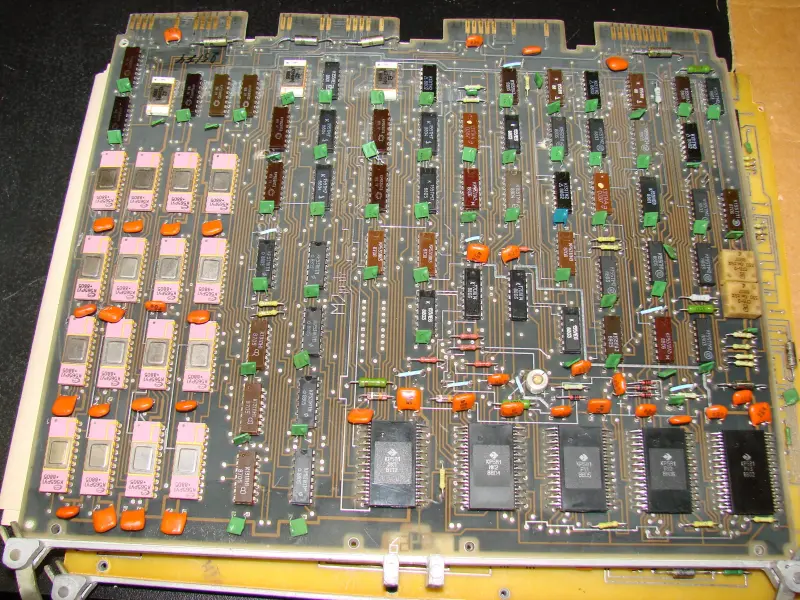 An Elektronika 60, the Soviet PDP-11 clone Alexey Pajitnov wrote the first Tetris on. It had no graphics hardware, so the pieces were drawn with bracket characters. Credit: Sergei Frolov, Soviet Calculators Collection. License: CC BY-SA 3.0.
He'd been playing with pentominoes, the twelve shapes you can make from five squares. Four squares turned out to be more fun.
Then came the part that shaped the next twelve years of his life. Pajitnov was a state employee. Anything he made on state time belonged to the state, and the arrangement he agreed to handed the rights to his own institute for ten years. He didn't sell Tetris because he had nothing to sell.
Meanwhile a colleague, Dmitry Pavlovsky, and a sixteen year old summer student named Vadim Gerasimov ported it to the IBM PC. That version went out on floppies, for free, and spread through Moscow and then out across the Eastern Bloc. By 1986 it was in Hungary, which is where Robert Stein found it.
Four kinds of rights, and nobody reading the labels
Stein ran a company called Andromeda Software. He telexed the Computing Centre, got a reply he chose to read as a yes, and started selling.
Mirrorsoft, owned by the British press magnate Robert Maxwell, took the European rights. Spectrum HoloByte took North America. Mirrorsoft shipped on January 27, 1988 and Spectrum HoloByte two days later. A hundred thousand copies moved in the first year. Spectrum HoloByte sublicensed onward to Atari Games, which built an arcade cabinet and, through its Tengen label, planned a version for the Nintendo Entertainment System.
Every one of those deals was written as though "the rights to Tetris" were a single object. There are computer rights, arcade rights, home console rights and handheld rights, and they can sit with four different parties. Nobody in the chain had pinned down which of those rights they'd actually bought.
The Soviet body that actually controlled the export was Elektronorgtechnica, universally shortened to ELORG. Its negotiator was Evgeni Belikov, whose patronymic Nikolaevich has been widely misread as a first name, which is why most retellings and the 2023 film call him Nikolai. ELORG had been watching royalties fail to arrive.
February 1989, three men, one city
Henk Rogers ran Bullet-Proof Software out of Tokyo. He had seen Tetris at the Consumer Electronics Show in Las Vegas, wanted it for Nintendo's unreleased Game Boy, and traced the license chain far enough back to see that it terminated in nothing. So he flew to Moscow on a tourist visa, without an appointment, without Russian, and walked into ELORG's offices.
Stein was in Moscow that month too, trying to repair his contract. So was Kevin Maxwell, sent by his father's company to buy the lot outright with the help of the family's political access. Three Western businessmen, the same week, the same building, the same game, and for a while none of them knew about the others.
Belikov used that. He sat Rogers down with Pajitnov, who was a games obsessive and got on with Rogers immediately. He also put a fresh contract in front of Stein containing a narrowed definition of "computer" that excluded consoles, wrapped in penalty clauses over late royalties. Stein signed. The console rights he thought he'd been arguing about had just been carved away from him in the document he was holding.
Rogers came back on March 15, 1989 with a lawyer, John Huhs. On March 22 Nintendo signed for console rights worldwide outside Japan and guaranteed ELORG a minimum of five million dollars.
The 268,000 cartridges
Nintendo sent Atari a cease and desist on March 31. Atari sued on April 18. Tengen's NES Tetris went on sale on May 17 anyway.
On June 21, 1989, Judge Fern M. Smith granted Nintendo a preliminary injunction and ordered the remaining stock destroyed. Tengen had ordered 300,000 cartridges at a cost of around three million dollars. Fewer than 100,000 had sold in four weeks. The other 268,000 were recalled and scrapped. Smith closed the matter on November 13, 1989, with the console rights confirmed as Nintendo's.
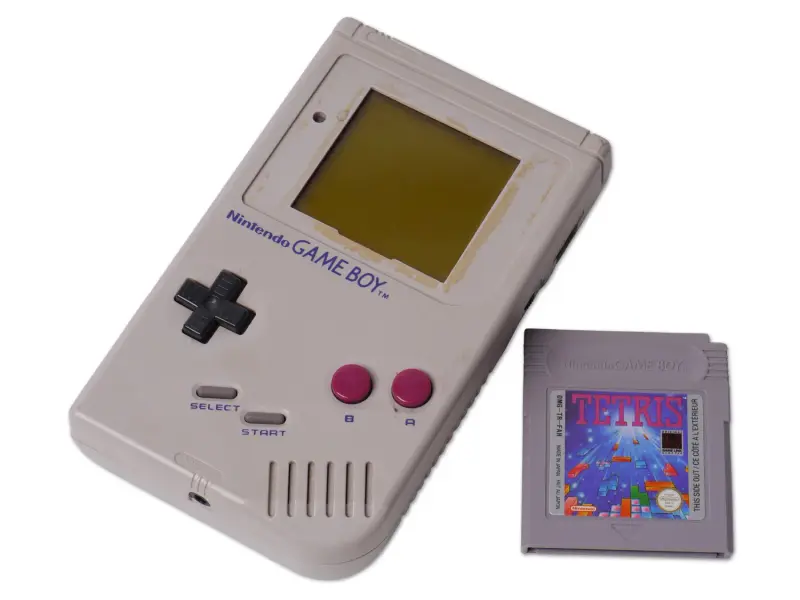
Game Boy reached American stores on July 31 that summer with Tetris in the box. That version has sold about 35 million copies.
Twelve years
Pajitnov saw none of it. His institute held the rights for the full ten years, and they reverted to him only at the end of 1995. In 1996 he and Rogers set up The Tetris Company as a partnership with ELORG, and Pajitnov collected his first payment for the game roughly twelve years after writing it. Rogers bought out the ELORG stake in 2005.
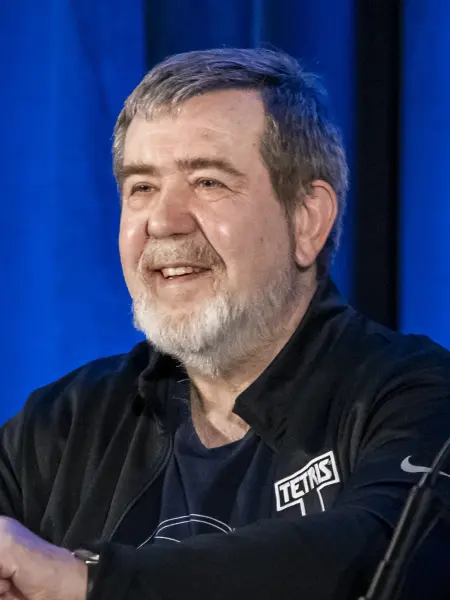 Alexey Pajitnov at GDC in 2024. He collected his first payment for Tetris roughly twelve years after writing it. Credit: Official GDC. License: CC BY 2.0.
Pajitnov has been asked about the irony more times than any person should be. A game written inside a system with no private property became one of the most licensed pieces of software in the world. He's said he doesn't regret it. He also doesn't pretend the arithmetic was fair.
The Tetris brand The Tetris Company controls today is what makes a modern release like Tetris Effect: Connected possible in the first place.

INTEL_SOURCES
- The Digital Antiquarian: A Tale of the Mirror World, Part 6 - Total War
- The Digital Antiquarian: A Tale of the Mirror World, Part 7 - Winners and Losers
- UPI Archives: Court blocks Tengen sale of Soviet designed video game
- Justia (US Court of Appeals, Federal Circuit): Atari Games Corp. v. Nintendo of America, Inc., 897 F.2d 1572
- Game Developer: Games Law History - the Tetris Saga
- CNN: Tetris - the Soviet mind game that took over the world
- INSEAD Publishing: Tetris Negotiation - Evgeni Nikolaevich Belikov (A)
- Wikipedia: Tetris (licensing history and Tengen litigation)
COMMENTS (0)
Be the first to comment